
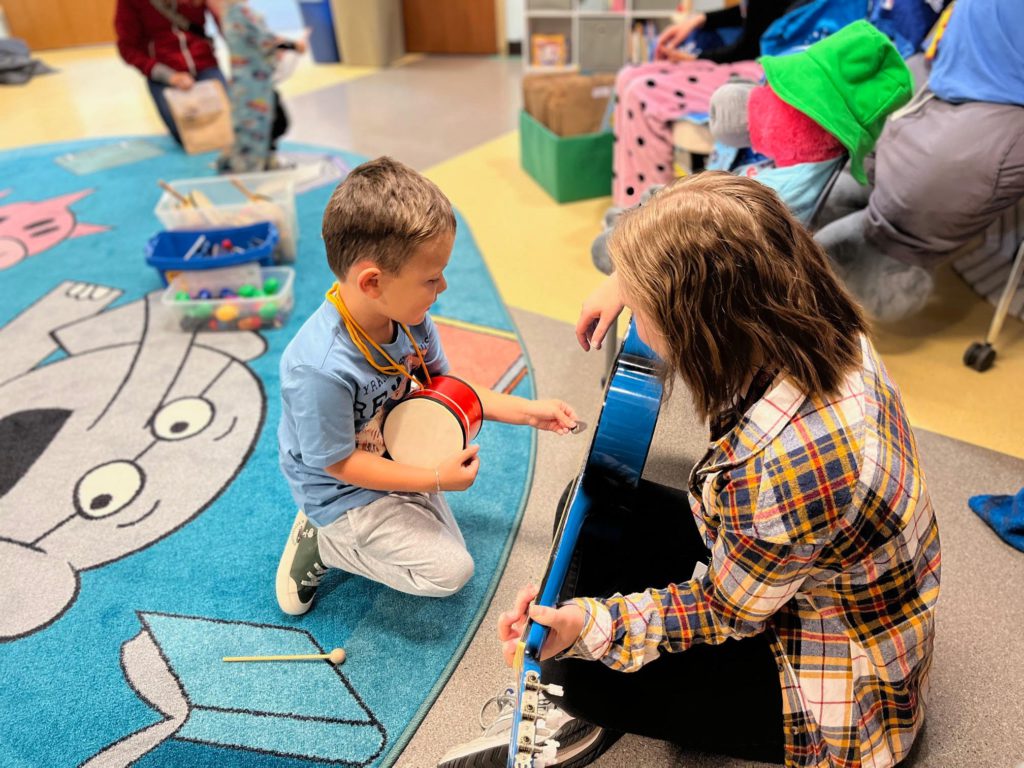
December 9, 2022 – From a white paper titled “The Importance of Play, Particularly Constructive Play, in Public Library Programming”
Play is vital for early learning. It is not “recess” or a “timeout” from learning, rather it IS the way young children learn.
Play can be defined in many ways, but normally three different kinds of play are delineated: (1.) Object Play, also known as exploratory play, from ages 0-2 (2.) Pretend Play, also described as imaginative play, or dramatic play, from ages 3-5 and (3.) Social Play, including Physical Play and Investigative Play, from ages 6-8. Young children, from birth through age eight, go through all three stages in play, with each stage building on the one before. (Jones, 2011.)
The Association for Library Service to Children (ALSC) and Public Library Association’s (PLA) joint project Every Child Ready to Read® 2nd edition” emphasizes the importance of play for the development of early literacy skills. Play is described as one of the best ways children can learn language and literacy skills. (Every Child Ready to Read®, 2011). It is also listed as one of five practices (talking, singing, reading, writing and playing) that are important for parents and caregivers to share regularly with their young children to help them get ready to read.
Through play, young children learn about their world. With this knowledge, they can understand books and stories once they begin to read. The first edition of the “Every Child Ready to Read®” project listed six skills necessary for children to successfully learn how to read and write. They included print awareness, letter knowledge, phonological awareness, vocabulary, narrative skills and print motivation, all of which can be learned through play.
Unfortunately, many parents, and even educators, do not appreciate the relevancy of play and how meaningful it is for children. Instead, there is often an increased demand for academics, both at home and at school. Kindergarten skills are being taught in some preschools, and numerous preschools reduce playtime in favor of forced learning, memorization, and drills. Additionally, parents are bombarded with media messages from the time their children are babies about the need to excel, and the value of certain products or enrichment tools to help their own child do so.
Librarians and educators have stressed the importance of brain research showing the importance of the first five years of a child’s life in synapses formation and brain development. Many parents have construed this to mean that they need to push their young child into the early acquisition of academic skills, engaging them in a wide variety of enrichment activities, many of which are not developmentally appropriate during these early years. Emphasis is placed on rote memorization, electronic toys, and computer or video games. Large periods of free open-ended play and guided play often seem unimportant or unnecessary, and not as significant as engaging children in activities that will help them “to get ahead.” Parents in some communities have concerns about safety and violence that force them to limit opportunities for their children to play outside.
Play is so important to optimum child development that it has been recognized by the United Nations High Commission for Human Rights as a right of every child. (Ginsburg, American Academy of Pediatrics, 2007). Thus, many pediatricians are emphasizing free play as a healthy and crucial part of childhood.